
Why Your Reps Keep Losing Buyer Meetings
Buyer meetings in FMCG are not like other sales meetings.
The buyer across the table has seen hundreds of reps this quarter. They know your category better than most people in your own company. They have twelve other suppliers waiting after you. And they will make a decision (or not) based on a 20-minute window that your rep either owns or wastes.
Most field sales teams leave that window to chance. The best ones build a system around it.
This guide is for sales managers and commercial directors who want to raise the floor on how their entire team presents, not just their top performers.
Why FMCG Buyer Presentations Fail
Before getting into what works, it's worth naming what typically goes wrong.
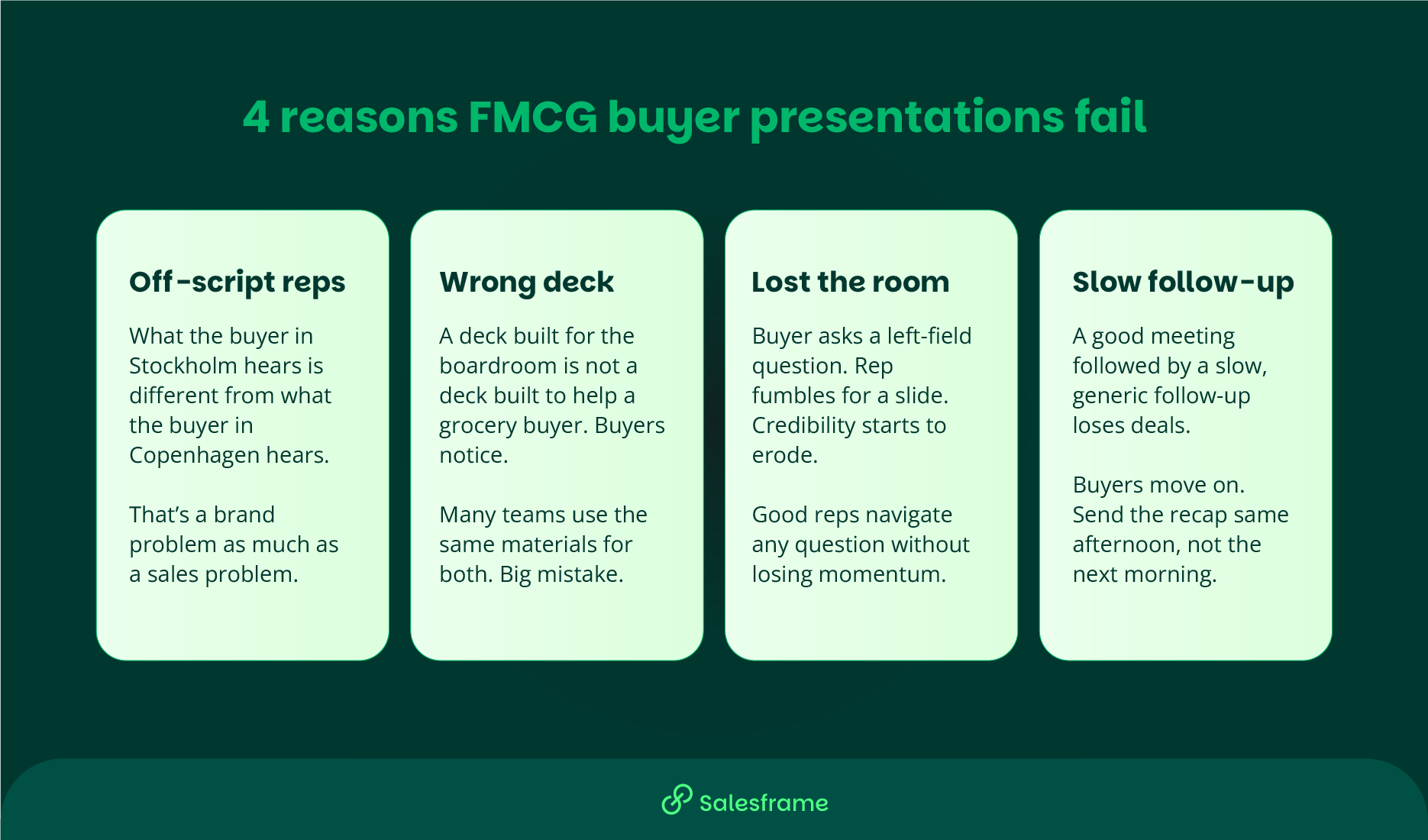
The rep goes off-script in the wrong direction. Not every deviation is bad — good reps read the room. But when reps improvise the core sales story, you get inconsistency across accounts, markets, and visits. What the buyer in Stockholm hears is different from what the buyer in Copenhagen hears. That's a brand problem as much as a sales problem.
The presentation isn't built for the buyer. A deck built for internal alignment, loaded with category strategy slides and company background, is not the same as a deck built to help a grocery buyer say yes to a new listing. Many teams use the same materials for both. Buyers notice.
The rep loses control of the room. A buyer asks a left-field question. The rep starts swiping through slides trying to find something relevant. The buyer watches them fumble. The credibility built in the first five minutes starts to erode.
The follow-up is weak or slow. A good meeting followed by a slow, generic follow-up loses deals. Buyers move on. The rep who sent a clean, relevant recap the same afternoon has the advantage.
These are structural problems. They're not fixed by coaching individual reps — they're fixed by building better systems.
What FMCG Buyers Actually Want From a Presentation
Understanding the buyer's perspective is the starting point for any presentation strategy.
Grocery buyers, brewery category managers, and food service buyers share a few common priorities regardless of market:
They want evidence, not enthusiasm. Sell-in data, category insights, shopper behaviour, velocity numbers from comparable markets — this is the language of a buyer meeting. Passion for the brand is good. Numbers that justify a listing decision are better.
They want it fast. Buyer calendars in FMCG are brutal. A presentation that takes 10 minutes to get to the point is a presentation that loses the room. Lead with the commercial opportunity. Context comes after.
They want to feel like this was built for them. A generic deck signals that your rep is going through the motions. A presentation that references their specific store format, their current category gaps, or a recent ranging decision they made shows preparation. That preparation signals partnership.
They want consistency across contacts. If a buyer deals with multiple reps from your team — regional reps, national account managers, merchandising teams — they expect to hear the same story. Conflicting messages create doubt.
Building a Presentation System for FMCG Field Sales
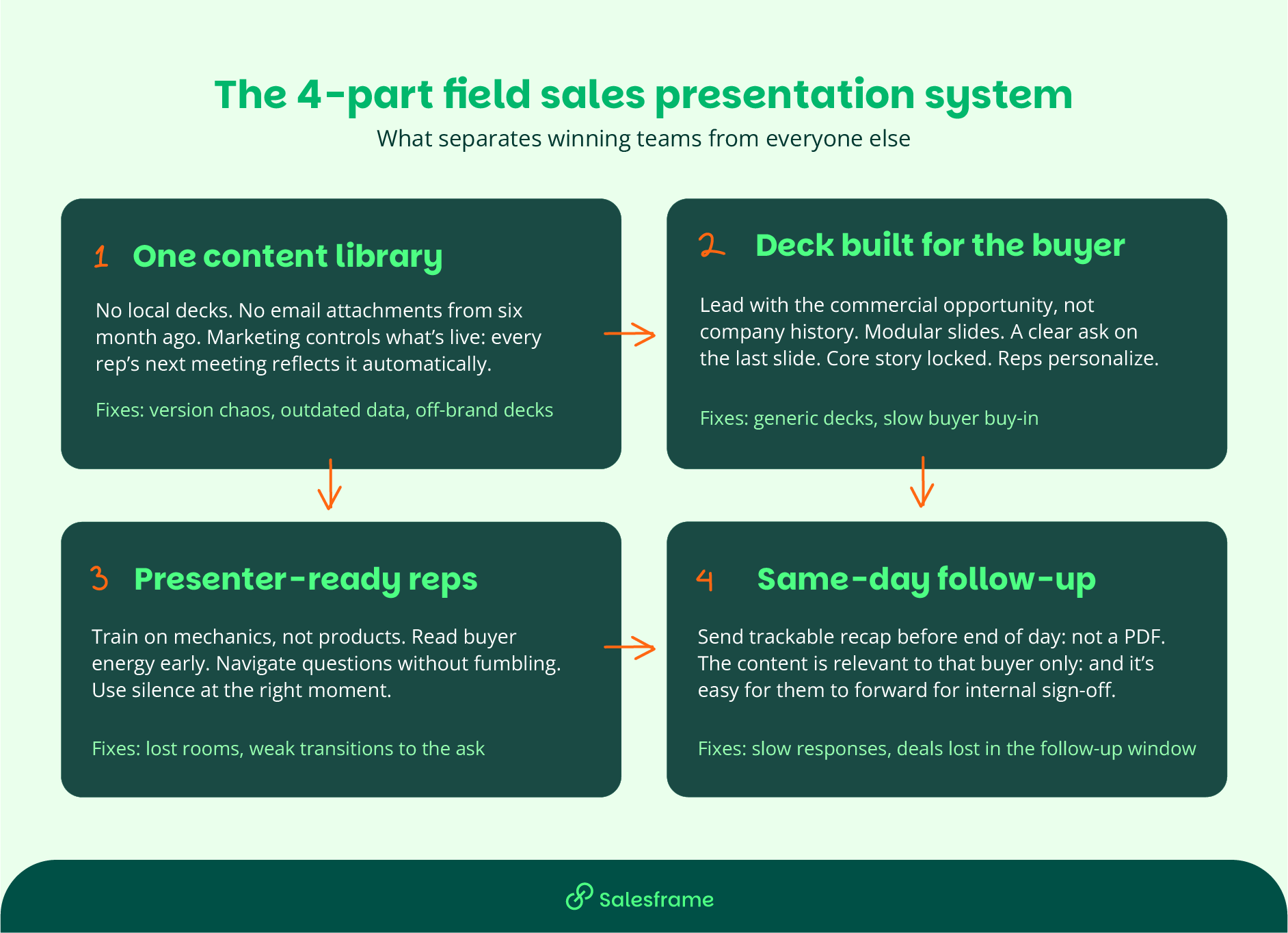
The shift from "each rep does their own thing" to a consistent, high-performing presentation system comes down to four components.
1. A Single Content Library That Stays Current
The biggest silent killer of FMCG field sales presentations is version chaos. Reps saving decks locally, pulling from old email attachments, using slides from last season's range review. By the time the buyer sees the presentation, the data is outdated and the products might have changed.
A single, centrally managed content library — where marketing controls what's available and reps pull from the same source — eliminates this. When a new product launches or a campaign goes live, every rep's next presentation reflects it automatically.
This is especially critical in categories with frequent range updates, like beverages and brewery, where promotional mechanics and seasonal SKUs change constantly.
2. Presentations Built for the Buyer Meeting, Not the Boardroom
Work with your marketing team to build presentation structures designed specifically for buyer-facing meetings. These should:
Lead with the commercial opportunity or category insight, not company history
Include modular slides that reps can include or exclude depending on the buyer's focus area
Be visual-first — planogram mockups, shelf layouts, campaign visuals land better than text-heavy slides in a fast-moving meeting
Have a clear ask on the final slide — a specific listing, a promotional commitment, a ranging decision
The core story should be locked. Reps should be able to personalise within it, not rewrite it.
3. Presenter-Ready Reps, Not Just Product-Ready Reps
Most FMCG sales training focuses on product knowledge and objection handling. Far less attention goes to the mechanics of presenting well in a live buyer meeting.
Train your reps on:
Reading the buyer's energy early. If a buyer opens by saying they have 15 minutes instead of 30, the rep needs to know which slides to drop without making it obvious. This is a skill that can be practised.
Controlling the room when questions come early. Buyers often interrupt. A rep who gets flustered when a buyer jumps ahead loses momentum. Reps should practise navigating to any slide in the deck instantly, without fumbling.
Using silence. After presenting a key data point or commercial opportunity, the instinct is to keep talking. The better move is to stop and let the buyer respond. Most reps are trained to fill silence. The best reps use it.
The transition to the ask. The moment a presentation shifts from "here's the opportunity" to "here's what we're asking for" is the most important transition in a buyer meeting. It should be deliberate and confident, not apologetic.
4. A Follow-Up Process That Closes the Loop
The meeting is not the end of the sales moment — it's the beginning of the decision window.
Best practice in FMCG field sales follow-up:
Send a recap the same day, not the next morning
Include only what's relevant to that buyer's specific situation — not the full deck
Make it easy to share internally (buyers often need to get sign-off from a category director or commercial lead)
Track whether the buyer opened it and which parts they engaged with — this tells you where their interest actually sits
Teams that follow up with a personalised, trackable link rather than a PDF attachment report faster response times and more productive second conversations.
Consistency at Scale: The Real Challenge for Sales Managers
Individual reps can be coached to present well. The harder challenge is making sure 20, 50, or 200 reps across multiple markets are all telling the same story — especially in distributed FMCG field sales teams where managers can't be in every meeting.
The tools that make this possible are:
A content system where the sales story is set centrally and reps can't accidentally deviate from it
Speaker notes or presentation guidance embedded in the deck itself, so reps carry the story with them into every meeting
Analytics on what content gets used and what gets skipped, so managers can identify where the story is breaking down in the field
Tools like Salesframe are built specifically for this — giving marketing and sales leadership control over the story while giving field reps the flexibility to present confidently in any customer situation.
The measure of a good field sales presentation system isn't how your best rep presents. It's how your average rep presents.
A Note on Brewery and Food Manufacturer Sales Specifically
Brewery and food manufacturer sales teams face a specific version of this challenge: the buyer relationship is long-term, the category is competitive, and the presentation cadence is high — seasonal reviews, promotional sell-ins, new product launches, ranging updates.
In this context, consistency isn't just a brand concern. It's a commercial one. A buyer who hears three different stories from three different reps across a quarter starts to lose confidence in the supplier, not just the rep.
The teams that win in these categories over time are the ones that have built a presentation system — not just a good deck.
Key Takeaways for FMCG Sales Managers
Lead buyer presentations with commercial evidence, not brand enthusiasm
Build presentations for the buyer meeting specifically — modular, visual, fast
Train reps on the mechanics of presenting, not just the content
Lock the core sales story centrally; let reps personalise around the edges
Follow up the same day with something trackable and relevant
Measure consistency across the team, not just performance at the top
Running a field sales team in FMCG, brewery, or food?
See how Salesframe helps sales managers keep the story consistent from HQ to the field — across every rep, every market, every visit.