
Retail Media Won't Stack Your Shelves
Retail media is getting a lot of attention right now. Grocery retailers are building out their own digital ad networks, CPG brands are shifting budget toward sponsored placements and on-site banners, and the industry press is treating it like the future of trade marketing.
Meanwhile, out in the field, reps are still walking into stores where the promotion was never set up, the POS materials are in a stockroom, and the agreed shelf position has been taken by a competitor.
Retail media and in-store activation are not competing strategies. But the explosion of interest in one is quietly drawing attention away from the other, and for most FMCG and CPG field teams, that's a problem worth naming.
What Retail Media Actually Is
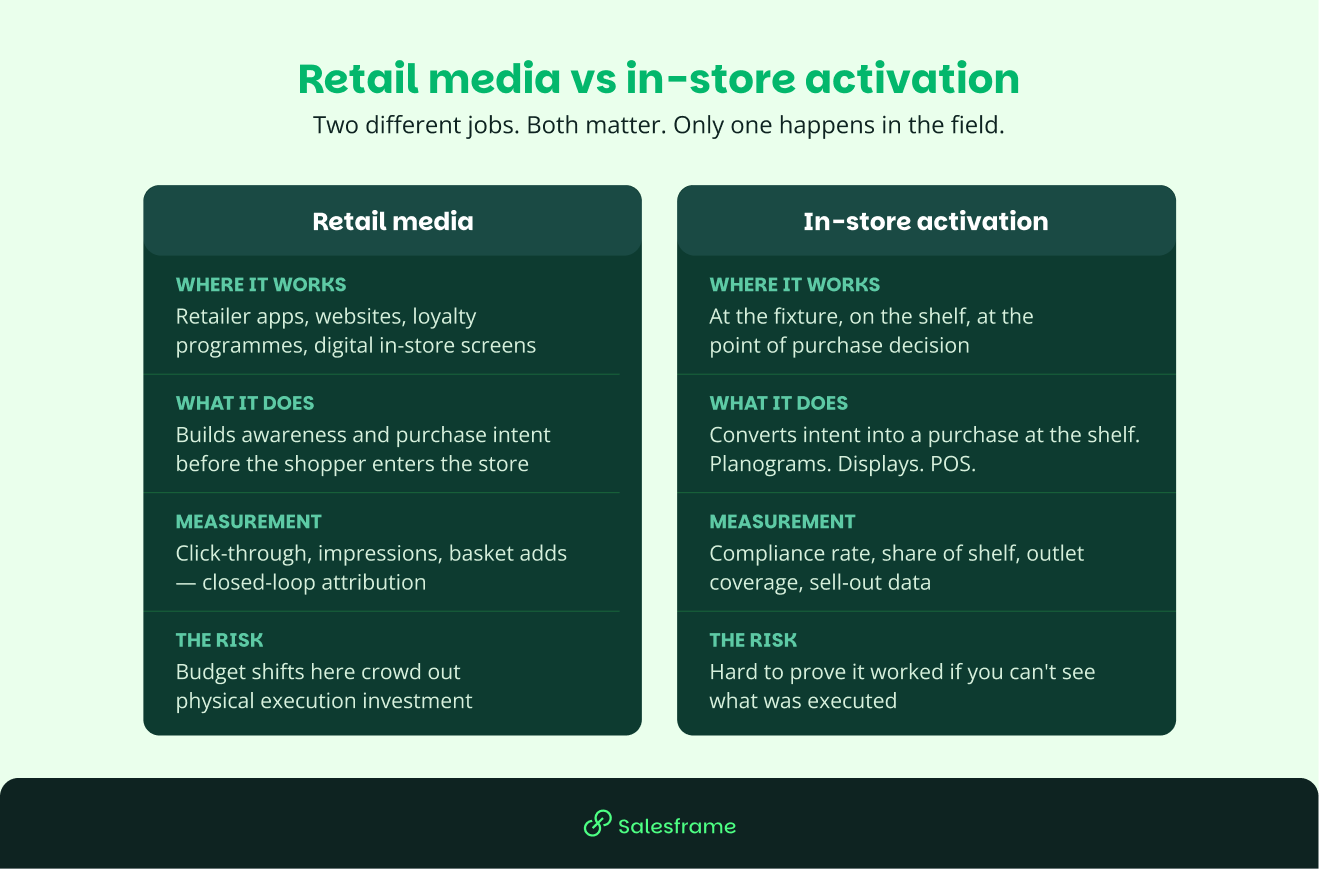
Retail media refers to advertising placements within a retailer's own ecosystem; sponsored search on a grocery app, banner ads on a retailer's website, digital screens in-store, or targeted promotions through a retailer's loyalty programme.
For especially larger FMCG brands, the appeal of retail media is obvious. Retailer first-party data connects ad exposure directly to purchase behaviour in a way that traditional media simply can't. A shopper who sees a sponsored placement for your product on a grocery app and adds it to their basket: that's a closed-loop signal most brand managers have spent years trying to create in real-life stores.
The global retail media market is growing fast. Major grocery retailers across Europe and North America (including Tesco, Carrefour, Walmart, and Kroger) have built out intricate, dedicated retail media networks. Budget that previously went to trade promotions or field activation is increasingly being redirected in retail media.
What In-Store Activation Actually Is
In-store activation covers everything that drives visibility and conversion at the physical point of sale: planogram compliance, display placement, POS material execution, promotional shelf strips, secondary placements, and outlet-level sell-in.
This is the work that field reps do every day. It's also the work that, according to most field sales managers, is the hardest to verify and the most inconsistently executed across accounts and markets.
When a promotion is agreed, a display is planned, and a secondary placement is negotiated: in-store activation is whether any of that actually happened. Not in theory. Not in the planogram. In the store, on the day, when the shopper walks in.
Research consistently shows that a significant proportion of agreed in-store activations are either partially executed or not executed at all by the time a field rep visits. The promotion ran. The budget was spent. The shopper never saw it.
Why the Comparison Is Happening Now
Field marketing managers are being asked to justify in-store activation budgets in a way they weren't five years ago. Retail media is measurable, attributable, and easy to report upward. A screenshot of a sponsored placement, a click-through rate, a conversion figure: these travel well in a board deck.
In-store activation, by comparison, has historically been hard to quantify.
Did the rep visit? Yes. Was the promotion set up? Probably. Was it set up correctly? Unknown. Was it still up a week later? No idea.
This visibility gap is where in-store activation loses the internal argument — not because it doesn't work, but because teams can't prove that it did.
The Real Question for Field Teams
The debate between retail media and in-store activation largely misses the point for field sales and trade marketing managers. The real question is not which channel to invest in. It's whether the work your field team is doing in physical retail is actually being executed, and whether you can see it in real time.
A retailer's digital ad network cannot put your product in the right shelf position. It cannot set up a secondary display at the end of an aisle. It cannot make sure the promotional price is showing correctly at the fixture. It cannot hand a sample to a shopper at the point of decision.
That is field team work. And if it's not being done — or not being done consistently — then no amount of retail media spend will recover the conversion that should be happening at the shelf.
What Good In-Store Activation Looks Like in Practice
The FMCG and CPG teams that make in-store activation work don't leave execution to chance. They treat it as a managed process with the same rigour they'd apply to any other commercial activity.
That means:
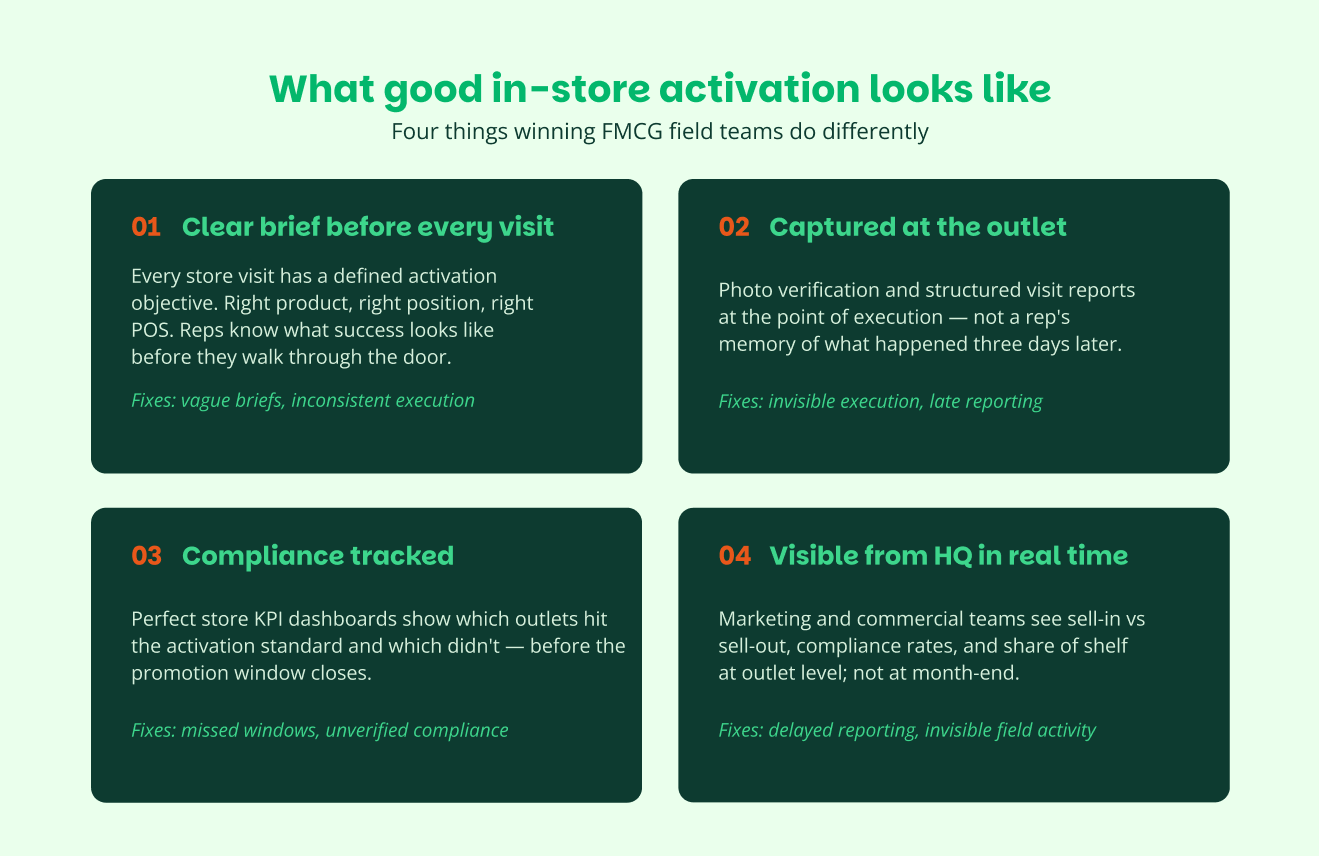
Reps arrive with a clear brief, not just a product list. Every store visit has a defined activation objective — a specific display to build, a specific shelf position to check, a specific POS material to place. The rep knows what success looks like before they walk through the door.
Execution is captured at the outlet, not reported from memory. Photo verification, structured visit reports, and real-time data capture at the point of execution give field managers actual visibility — not a rep's recollection of what they did three days ago.
Compliance is tracked, not assumed. Perfect store frameworks and outlet-level KPI dashboards tell field managers which stores hit the activation standard and which didn't — so problems get fixed before the promotion window closes, not after the fact.
Follow-through is measured from HQ. Marketing and commercial teams can see sell-in vs sell-out data, activation compliance rates, and share of shelf at the outlet level without waiting for a field manager to collate reports at the end of the month.
This is what field sales enablement and retail execution platforms are built to do — give field teams the tools to execute consistently and give sales leadership the visibility to know whether they did.
The Budget Conversation
Most FMCG and CPG marketing directors are not choosing between retail media and in-store activation. They're doing both and being asked to do more with the same budget.
In that context, the smarter question is: what's the return on in-store activation if it's actually executed correctly? Because for many brands, the answer is that a well-executed physical activation at the right outlet, at the right moment in the purchase journey, still outperforms digital exposure for driving immediate conversion.
The problem is not that in-store activation doesn't work. The problem is that it's too often done inconsistently, too hard to measure, and too easy to underfund once the comparisons start being made with retail media's cleaner attribution story.
Fix the execution. Fix the measurement. The budget case takes care of itself.
What This Means for Field Sales Managers
If you're managing a field team in FMCG, CPG, alcohol, or tobacco, here's what the retail media conversation should be prompting you to do:
Get visibility into execution before the next review. If you can't tell your commercial director whether last quarter's trade promotion was actually set up in 60% or 90% of target outlets, you're going into that meeting at a disadvantage.
Build a perfect store standard your reps can actually hit. Vague activation briefs produce inconsistent execution. Specific, outlet-level standards (right product, right position, right POS, right price) give reps something to aim at and managers something to measure against.
Make the data work for you. Retail media's advantage is measurement. In-store activation can have that too, if the right tools are in place to capture what's happening at the outlet level in real time.
Don't cede the shelf. Digital visibility drives intent. In-store execution drives conversion. Both matter. Letting one atrophy while the other gets budget is how brands lose share of shelf without realising it until a range review comes around.
Key Takeaways
Retail media and in-store activation serve different moments in the purchase journey. Digital builds intent, physical execution drives conversion at the shelf
The main reason in-store activation loses the internal budget argument is poor measurement, not poor results
Field teams that capture execution data at the outlet level can make the same attribution argument that retail media makes
A well-executed physical activation at the right outlet still drives strong conversion: the issue is consistency across the field force
Perfect store compliance, real-time outlet KPI tracking, and structured visit reporting are the tools that close the visibility gap
Running a field team in FMCG or CPG? Salesframe helps sales managers track in-store activation compliance, outlet coverage, and field force performance in real time — so you always know whether the work got done.