
Field Sales KPIs That Actually Tell You Something
Every field sales manager has a dashboard. Most of them have too many numbers on it.
Calls logged, kilometres driven, outlets visited. hours in field. The CRM looks full, the weekly report seem healthy, and nobody can explain why the promotion that ran last month didn't shift volume the way it was supposed to.
The problem isn't a lack of data: most likely it’s that the data most field teams track measures activity rather than outcomes. And activity is easy to generate without moving the needle on anything that matters in business.
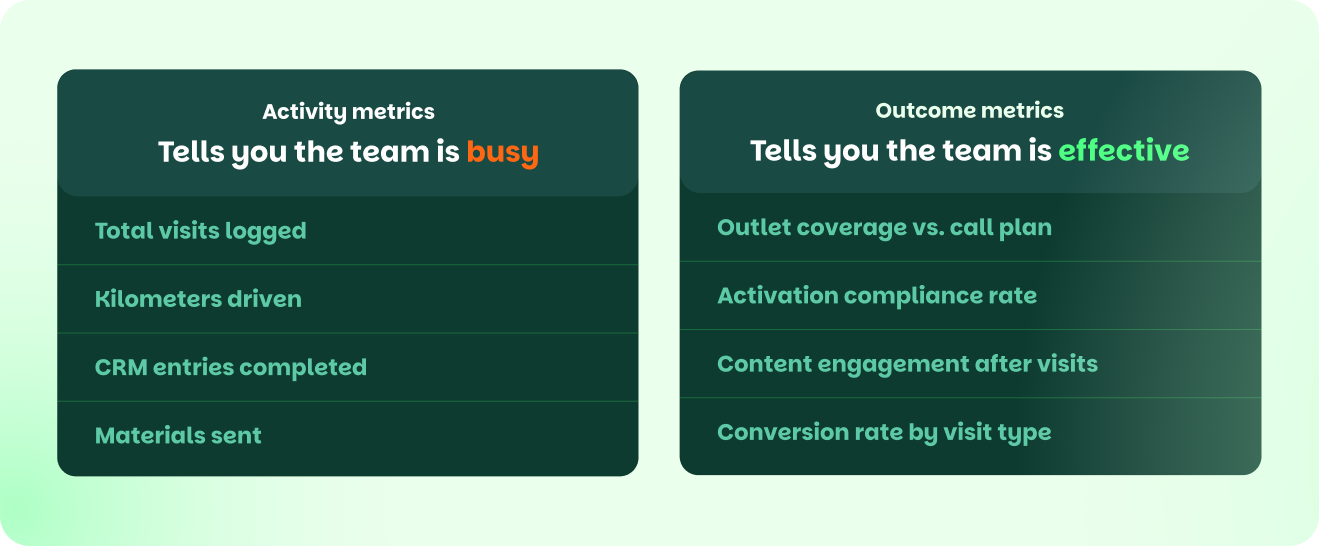
This is the main difference between KPIs that tell you your team is busy and KPIs that tell you your team is effective.
The KPIs that feel useful but usually aren't
These show up on almost every field sales dashboard. They're not worthless, but on their own, they tell you very little.
Total visits logged
A rep who visits 12 outlets a day and has no meaningful conversation at any of them is outperforming a rep who visits 8 and closes a new listing at two of them. Volume without quality is noise. Total visits only becomes useful when it's segmented by outlet tier, geography, or conversion outcome.
Kilometres driven / time in field
This measures presence, not performance. A rep can spend eight hours in the field, drive 200 kilometres, and accomplish nothing that moves a commercial outcome. Tracking this made more sense when field teams had no digital tools and physical presence was the only proxy for effort. It's 2026, and the situation is different.
CRM entries completed
Call reports filled in on time say something about admin compliance. They say nothing about whether the visit was any good. If your primary signal for field performance is whether the CRM got updated, you're measuring the paperwork, not the work.
Number of presentations sent
Sending materials is not the same as engaging a buyer. A rep who sends 20 follow-up links and has zero opens is performing worse than one who sends five and gets four opened, read, and responded to. Volume metrics for content sharing only mean something when you can see what happened after the send.
The KPIs that actually tell you something
These are harder to track without the right tools. That's partly why they're less common, and partly why the teams that do track them tend to outperform the ones that don't.
Outlet coverage rate against the call plan
Not just "how many outlets did the rep visit" but "how many of the right outlets did the rep visit, at the frequency they were supposed to." A rep who visits 90% of their assigned outlets on the correct call cycle is executing differently from one who visits the same total number but cherry-picks the easy ones. Coverage rate against plan is one of the most direct measures of field discipline you have.
Active selling time per visit
The percentage of a store visit actually spent in front of a buyer, as opposed to waiting, travelling between departments, or dealing with administrative tasks. Most FMCG field teams have never measured this: and when they do, the number is lower than expected. Improving active selling time per visit is one of the highest-leverage changes a field sales manager can make, because it doesn't require hiring more reps.
In-store activation compliance rate
When you brief a promotional display, a planogram change, or a POS placement: which percentage of outlets actually execute it correctly? This is the question most FMCG trade marketing teams cannot answer without sending a separate audit team. But it's the most direct measure of whether your trade investment is being converted into shelf space and visibility. Compliance rate by chain, by region, or by campaign gives you something actionable. "We ran an activation" does not.
Content engagement after visits
If your reps send follow-up materials to buyers after store visits, you should know whether those materials get opened, which sections get time spent on them, and whether engagement correlates with outcomes like listings, orders, or promotional agreements. A buyer who opens your follow-up link three times in 24 hours is behaving differently from one who never opens it. That signal is available, most teams just don't capture it.
Conversion rate by visit type
Not all store visits have the same objective. A routine coverage call, a new listing pitch, a promotional sell-in, and a compliance check-up are different activities with different success criteria. Tracking conversion rate by visit type (what percentage of new listing pitches result in a listing, what percentage of promotional sell-ins get confirmed) gives you far more useful data than aggregate visit counts.
Sell-out velocity after sell-in
You got the listing. You got the display. Did it actually move product? Connecting field activity data to sell-out performance at outlet level is the gold standard for FMCG field sales measurement — and genuinely difficult to do at scale without EPoS integration. But even a rough version of this, tracked for key accounts or key SKUs, tells you whether your field execution is translating into commercial results.
Why most teams track the wrong things
The activity metrics (visits, kilometres, CRM entries) are easy to collect because they're generated automatically or require minimal effort from reps. The outcome metrics require either better tooling, better data integration, or both.
There's also a cultural dimension. Activity metrics feel fair to track because they're within the rep's direct control. A rep can always log another call or drive another route. Outcome metrics feel riskier to enforce because external factors (a buyer being unavailable, a chain running a category review, a competitor promotion) affect results in ways the rep can't fully control.
Both points are valid. But the answer isn't to abandon outcome metrics, it's to track them with enough context that you can separate rep performance from market conditions. A rep with a low activation compliance rate in a chain that's notoriously difficult to execute in is different from a rep with a low rate in an account where three colleagues are hitting target.
Context doesn't invalidate the metric. It makes it more useful.
A practical starting point
If your current field sales measurement is mostly activity-based and you want to move toward outcome-based tracking, you don't need to overhaul everything at once.
Start with two changes.
First, add outlet coverage rate against the call plan to your weekly review. Compare it across reps and regions. You'll quickly see whether your call plan is being followed, and where it isn't, you'll have a conversation starter that goes beyond "you need to do more visits."
Second, if your reps are sending follow-up materials after visits, start tracking what happens to them. Open rate, time spent, which sections get attention. If you don't have that visibility today, it's worth asking why, because the data is there, it's just not being captured!
Those two shifts (from total visits to coverage compliance, and from materials sent to materials engaged with) will tell you more about field performance than most dashboards do today.
The rest follows from there.
Salesframe is a field sales enablement platform for FMCG and CPG companies. It gives field teams one place to prepare, present, follow up, and track what works — and gives managers the visibility to see what's happening across the field.