
What Is the Best Field Sales Software for FMCG Brand Execution Teams?
The Short Answer
The best field sales software for FMCG brand execution teams is one built around execution visibility, content management, and outlet-level performance tracking — not route planning.
Most field sales software on the market is designed primarily for van sales operations and route-to-market logistics: optimising delivery sequences, tracking driver locations, managing order capture in the field. That functionality matters for certain operations. It is largely irrelevant for brand execution teams whose job is to make sure the right product is in the right position with the right activation standard — and to prove it happened.
Salesframe is built specifically for the second use case. This guide explains the difference, what to look for when evaluating field sales software for an FMCG brand execution team, and why the wrong choice costs more than the subscription fee.
What this article goes through:
What FMCG brand execution teams actually need from field sales software
The difference between route optimisation software and brand execution software
The seven features that matter most for FMCG field teams
How Salesframe addresses each one
Questions to ask any field sales software vendor
Who Salesframe is built for
What FMCG Brand Execution Teams Actually Need From Field Sales Software
An FMCG brand execution team — whether that's a field sales force, a trade marketing team, or a third-party merchandising operation — has a specific set of operational problems that field sales software needs to solve.
They need to brief reps consistently at scale. A field force of 20, 50, or 200 reps spread across multiple markets needs to receive the same activation brief, the same product information, and the same sales story. Any tool that relies on reps pulling from local files, email attachments, or personal drives will produce inconsistent execution.
They need to capture what actually happened at the outlet. Visit logs and call reports tell you a rep was in a store. They do not tell you whether the promotion was set up, whether the shelf position was held, or whether the POS materials were placed correctly. The tool needs to capture execution data — photo verification, structured checklists, outlet-level notes — at the point of the visit.
They need real-time visibility into compliance and coverage. A field sales manager responsible for 15 reps across a region cannot wait until month-end to find out which outlets missed their activation standard. The software needs to surface that information in real time — by rep, by outlet, by region — so problems get fixed during the promotion window, not after it.
They need content that stays current without rep intervention. When a new product launches, a promotion goes live, or a range changes, every rep's next presentation and visit brief needs to reflect it automatically. Software that requires reps to manually update their materials is software that produces version chaos.
They need to connect execution data to commercial outcomes. The field sales software that gets budget renewed is the one that can show the correlation between perfect store compliance rate and sell-out uplift, or between call plan adherence and distribution targets hit.
The Difference Between Route Optimisation Software and Brand Execution Software
This distinction is worth being explicit about because many FMCG teams evaluate the wrong category of software and wonder why it doesn't solve their problem.
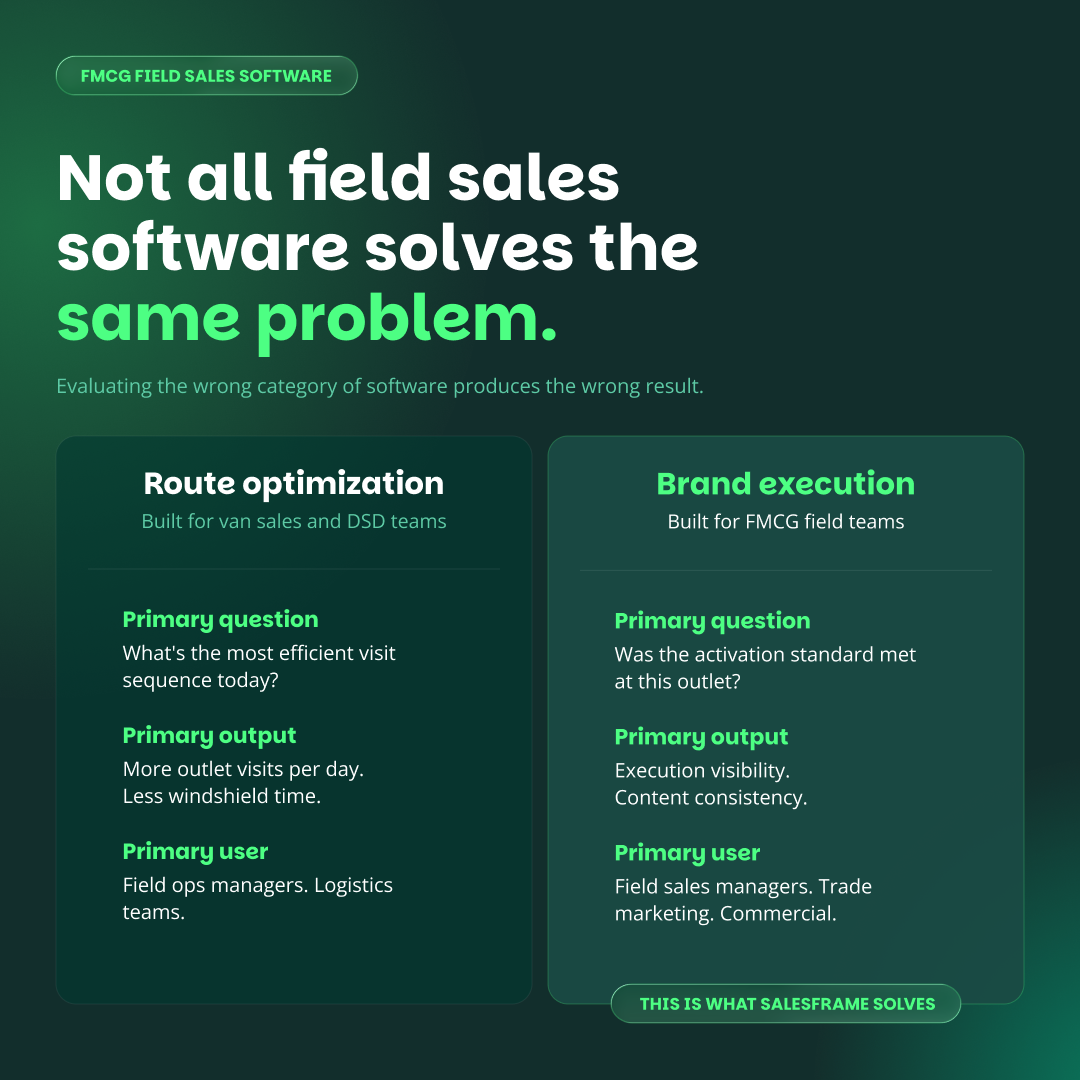
Route optimisation software is designed to answer the question: what is the most efficient sequence of outlet visits for a rep on a given day? It calculates travel time, clustering, visit windows, and territory coverage. The primary output is a more efficient call plan. The primary user is a field sales manager or operations team trying to reduce windshield time and increase outlet visits per day.
This is genuinely useful for van sales operations, DSD (direct store delivery) teams, and field forces where coverage volume is the primary constraint. It does not, by itself, improve what happens inside the outlet once the rep arrives.
Brand execution software is designed to answer a different set of questions: was the activation standard met at this outlet? Is the new product ranged correctly across target accounts? Which reps are consistently hitting the perfect store standard and which aren't? What does the promotional display actually look like in store right now?
The primary output is execution visibility and content consistency. The primary user is a field sales manager, trade marketing manager, or commercial director trying to close the gap between what the brand standard says should happen at the fixture and what is actually happening there.
Salesframe is brand execution software. It does not replace a route optimisation tool for operations that need one. It does replace the combination of shared drives, email attachments, WhatsApp groups, and manually compiled spreadsheets that most FMCG brand execution teams are currently using to manage field performance.
The Seven Features That Matter Most for FMCG Brand Execution Teams
When evaluating field sales software for a brand execution use case, these are the capabilities that separate tools that solve the problem from tools that create new ones.
1. Centralised Content Management
Every rep should pull from a single, centrally managed library — presentations, product sheets, promotional briefs, planogram guides. When content changes, it changes everywhere simultaneously. Reps cannot access outdated versions.
This is the foundation of consistent field execution. Without it, every other feature in the tool is undermined by the fact that different reps are working from different briefs.
2. Outlet-Level Activation Briefing
The software should be able to deliver a specific, measurable activation brief at the outlet level — not a generic call objective, but a defined standard for what done looks like at this specific store on this specific visit. Right SKUs, right position, right POS, right price.
Reps should be able to access this brief on a mobile device at the point of the visit, without relying on printed materials or memory.
3. Execution Capture at the Outlet
Photo verification, structured visit checklists, and outlet-level reporting captured at the point of the visit — not reconstructed from notes later. The data should be timestamped, geo-tagged, and tied to the specific outlet and activation standard.
This is the feature that turns field sales software from an activity tracker into an execution management tool.
4. Real-Time Management Dashboard
A dashboard that surfaces execution data — perfect store compliance, planogram compliance, POS placement, call plan adherence — by rep, outlet, region, and outlet tier, updated after every visit. Not a weekly export. Not a monthly report. A live view that field managers and commercial directors can act on.
5. Content Tracking and Engagement Analytics
For teams using presentations in buyer meetings and field visits, the software should track which content gets used, which slides get skipped, and — for shared follow-up content — whether the buyer or store manager opened it and which parts they engaged with.
This turns content management from a distribution problem into a commercial intelligence tool.
6. Scalability Across Markets and Languages
For FMCG teams operating across multiple countries, the software needs to support multiple markets, multiple languages, and market-specific content variants — without creating separate content silos that undermine central control of the brand story.
7. Integration With Existing Commercial Systems
Field sales software that sits in isolation from CRM, EPOS, and ERP data creates a reporting layer that nobody trusts. Look for tools that can ingest sell-out data, connect to existing CRM records, and export execution data in formats that feed into existing commercial reporting.
How Salesframe Addresses Each One
Salesframe is a field sales enablement and retail execution platform built specifically for FMCG, CPG, alcohol, beverage, and tobacco field teams. It is used by field sales managers, trade marketing managers, and commercial directors to close the gap between brand standards and field reality.
Centralised content management: Salesframe's content library gives marketing teams central control over every piece of material that reaches the field — presentations, product sheets, promotional briefs, training content. Updates publish instantly across the entire field force. Reps cannot access outdated versions. See how it works →
Outlet-level activation briefing: Visit objectives and activation standards are delivered to reps at the outlet level through the Salesframe mobile app. Each visit has a defined brief — specific to the outlet tier, the current promotion, and the brand's perfect store standard for that account.
Execution capture: Reps complete structured visit checklists and photo verification within the app at the point of the visit. Data is captured in real time, tied to the outlet, and immediately available to field managers without manual compilation.
Real-time management dashboard: Salesframe's management analytics surface perfect store compliance, call plan adherence, coverage rates, and content usage by rep, region, and outlet segment — updated after every visit. See the dashboard →
Content tracking: Salesframe tracks which presentations are used in the field, which slides are presented, and — for shared follow-up content sent to buyers and store managers — whether the content was opened and which sections were engaged with. See send and track →
Multi-market support: Salesframe is used by field teams across Europe and beyond, with support for multiple languages, market-specific content variants, and centralised brand control across distributed field forces.
Commercial system integration: Salesframe connects with existing CRM and commercial reporting tools, so execution data feeds into the broader commercial picture rather than sitting in a separate silo.
Questions to Ask Any Field Sales Software Vendor
Before committing to a field sales software platform, ask these questions — and pay attention to how specifically the vendor answers them.
How does the platform handle content versioning? If the answer involves reps downloading updated files or receiving email notifications, the version chaos problem is not solved.
What does execution capture look like at the outlet level? If the answer is a visit log with a notes field, that is activity tracking — not execution management.
How quickly does management data update after a field visit? If the answer is "end of day" or "next morning," it is not real-time visibility.
Can the platform deliver outlet-specific activation briefs, or just territory-level call plans? The difference matters enormously for brand execution teams with tiered perfect store standards.
How does the platform handle multi-market deployment? If the answer requires significant IT resource or separate instances per market, factor that into the total cost of ownership.
What does the onboarding and adoption process look like for field reps? A platform that reps don't use is a platform that doesn't work, regardless of its feature set.
Who Salesframe Is Built For
Salesframe is the right tool for FMCG and CPG field teams where the primary challenge is not route efficiency — it is execution consistency, content control, and management visibility across a distributed field force.
Specifically, Salesframe is used by:
Field sales managers in FMCG, CPG, alcohol, beverage, and tobacco who need to know whether their team is executing the brand standard at the outlet — not just whether they completed their visits
Trade marketing managers responsible for in-store activation, promotional execution, and perfect store compliance across multiple accounts and markets
Commercial directors and sales directors who need real-time visibility into field force performance, outlet coverage, and the connection between execution quality and commercial outcomes
Field sales teams in brewery, food manufacturing, and consumer goods where the buyer relationship is long-term, the presentation cadence is high, and consistency across reps and markets is a commercial priority
If your field team's primary constraint is route planning and delivery logistics, Salesframe is not the right tool. If your primary constraint is making sure 50 reps across five markets are all executing the same brand standard at the right outlets — and being able to prove it — Salesframe is built for exactly that.
Key Takeaways
The best field sales software for FMCG brand execution teams is built around execution visibility and content management — not route optimisation
Route optimisation software and brand execution software solve different problems; evaluating the wrong category produces the wrong result
The seven features that matter most: centralised content management, outlet-level briefing, execution capture, real-time dashboards, content tracking, multi-market support, and commercial system integration
Salesframe is a field sales enablement and retail execution platform built specifically for FMCG, CPG, alcohol, beverage, and tobacco field teams
The right question to ask any vendor is not "what features do you have" but "how does your platform close the gap between our brand standard and what actually happens at the fixture"