
Field sales teams run on assumptions. Some of those assumptions were built from real experience. Some were built from things that sounded right in a planning meeting and never got tested against what actually happens in a store.
Here are 5 that come up constantly, and what the reality looks like.
Myth 1:
Route planning tells you whether your reps are executing
Route planning tells you where the rep went. It does not tell you what happened when they got there.
A completed visit on the schedule means the rep was in the outlet. It does not mean the POS materials went up, the secondary placement was built, or the promotion ran the way it was briefed. Most field sales managers know this, and most still have no reliable way to find out the truth until a buyer tells them something went wrong.
Outlet coverage is a KPI. In-store execution is a different question entirely, and it needs different data.
Myth 2:
Your reps have a shared understanding of what "perfect store" looks like
The reps who have been doing this for a decade have an instinct for a well-executed display. The rep who joined in January does not. And when you roll out a new planogram, a new POS format, or a new chain, even experienced reps are working from a written brief and their own interpretation of it.
The teams with the most consistent in-store execution share photos. Not in a WhatsApp group that nobody can search, but in a feed where a rep covering a new territory can see, in thirty seconds, exactly what good looks like in that chain. That is what Scout does.
When people can see the standard instead of read about it, the standard travels.

Compliance can be followed, but it needs a system.
Myth 3:
You will find out about trade promotion non-compliance from your own data
You probably won't. Most FMCG companies find out about execution failures from a buyer complaint, a competitor gaining shelf space, or an end-of-month sales figure that does not add up.
The sell-in went through. The sell-out data tells you something happened. What it cannot tell you is whether the gondola end was yours, whether the promotional pricing was applied, or whether the display was actually built before week two of the campaign. That gap is where trade promotion budget quietly disappears, and it is wide.
The teams that catch it early enough to do something about it have real-time documentation from the field, not a monthly report.
Myth 4:
Reps won't adopt new tools
This gets used to justify keeping processes in place that everyone knows are broken. The actual pattern is more specific: reps do not adopt tools that feel like administrative overhead or surveillance. They adopt tools that make them better in front of a buyer.
A rep who can walk into a store visit with current, well-organised materials, without spending twenty minutes hunting through a SharePoint folder the night before, has a reason to use the tool. A rep who can send a trackable follow-up link within the hour instead of forwarding a PDF has a reason to use it again. Adoption follows daily value. It does not follow a training mandate.
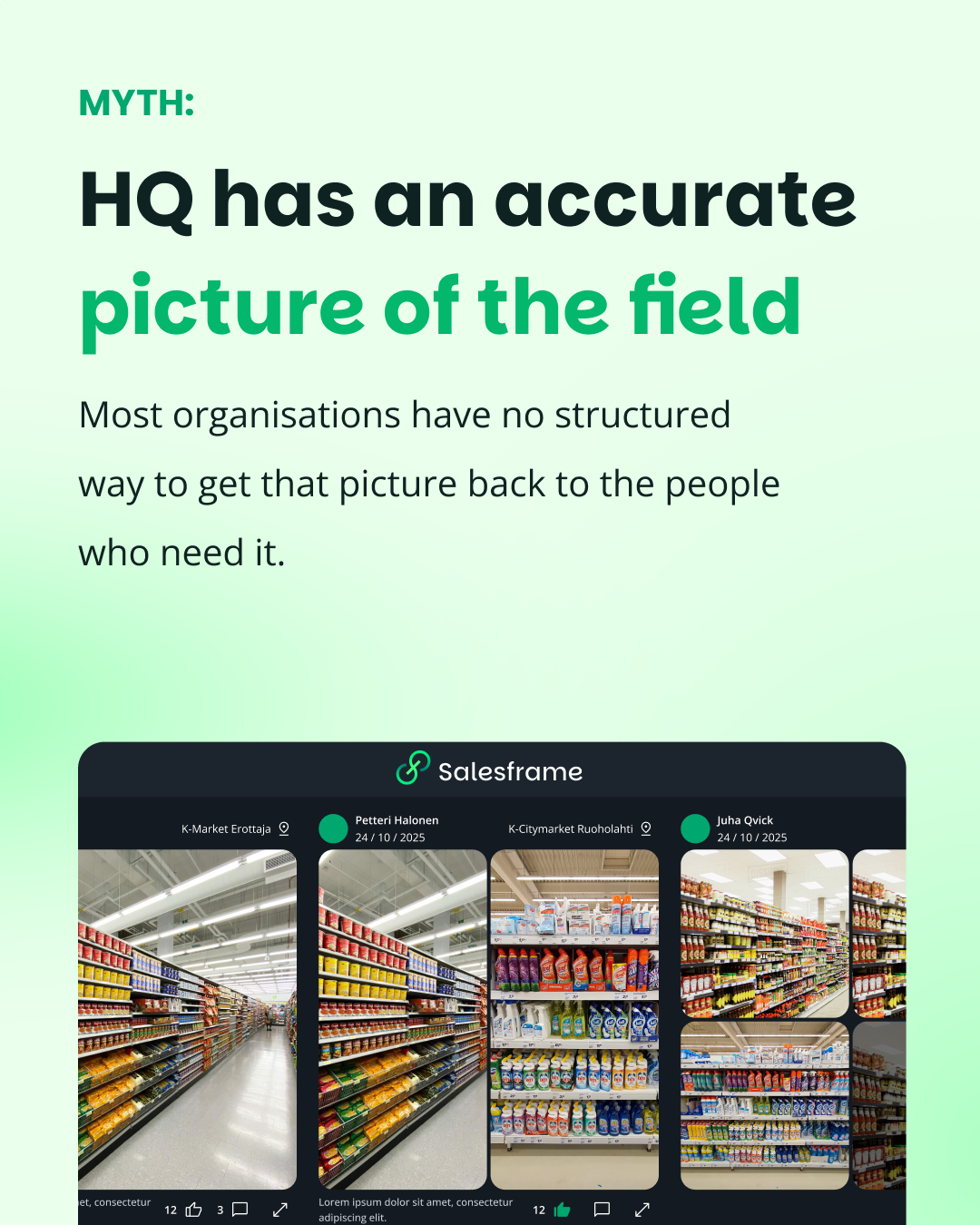
The only way to see the field is for the reps to bring it to the HQ.
Myth 5:
Head office has a reasonable picture of what is happening in the field
Sales reports give you numbers. Field managers give you narratives. Both are filtered, delayed, and summarised before they reach anyone with a budget to reallocate.
The real picture of your retail execution, what outlets look like right now, which activations are actually running, where coverage has dropped, lives with the people doing the visits. Most organisations have no structured way to get that picture back to the people who need it. The reps closest to the shelf are generating information constantly. Very little of it travels upstream in a form anyone can act on.
That is a workflow problem, not a motivation problem. When capturing what happened in a store takes thirty seconds and lands in a feed the whole team can see, it happens. When it requires a separate system and a report nobody reads until month-end, it does not.
What connects all five
None of these myths survive once there is real visibility into what happens between the rep leaving the warehouse and the buyer signing off on a display. The information already exists. It is in the field, in the stores, in the photos reps are already taking on their phones.
Getting it into a form the rest of the organisation can act on is what separates the teams with clean execution from the ones who find out too late.