
Great RTM strategy! Shame about the execution
Route to market is one of those terms that can mean everything or nothing, depending on who's using it.
In a strategy deck, it describes the channels, partners, and go-to-market approach that gets your product from the factory to the end consumer. It covers:
Distribution agreements
Wholesaler relationships
Direct vs indirect coverage
Channel prioritisation
And outlet segmentation.
In the field, it's simpler than that. Route to market is the answer to a practical question: which outlets does your rep visit, in what order, how often, and with what objective?
The gap between those two definitions is where most FMCG and CPG route to market strategies break down. The plan is sound. The execution is inconsistent. And by the time anyone notices, the window to fix it has usually closed.
What Route to Market Actually Covers
A route to market strategy in FMCG typically addresses four things:
Channel selection. Which trade channels does the brand compete in: modern trade, traditional trade, on-trade, off-trade, foodservice, convenience, pharmacy? Each channel has different margin structures, different buyer relationships, and different execution requirements at the outlet level.
Distribution model. How does product reach the outlet? Direct delivery via a van sales operation, through a distributor or wholesaler network, or a hybrid of both? The distribution model determines how much control the brand has over what happens at the point of sale.
Outlet segmentation. Not all outlets are equal. A route to market strategy defines which outlet types to prioritise, what the coverage target is for each segment, and what the activation standard looks like by outlet tier — from flagship accounts down to convenience stores in secondary markets.
Field force design. How many reps, covering what geography, visiting which outlets, at what frequency? Field force design is the operational expression of the route to market strategy, the mechanism by which the plan actually touches the shelf.
Get any of these four things wrong and the strategy underdelivers. Get the field force design wrong in particular (too few reps, wrong coverage priorities, no clarity on what each visit should achieve) and the rest of the strategy is largely hypothetical.
Where Route to Market Strategies Break Down in Practice
Most route to market strategies are built by commercial and marketing teams working from sales data, category insight, and channel analysis. They are sound, defensible plans. They also tend to share a common blind spot: they assume that what gets planned gets executed.
In FMCG field sales, that assumption rarely holds.
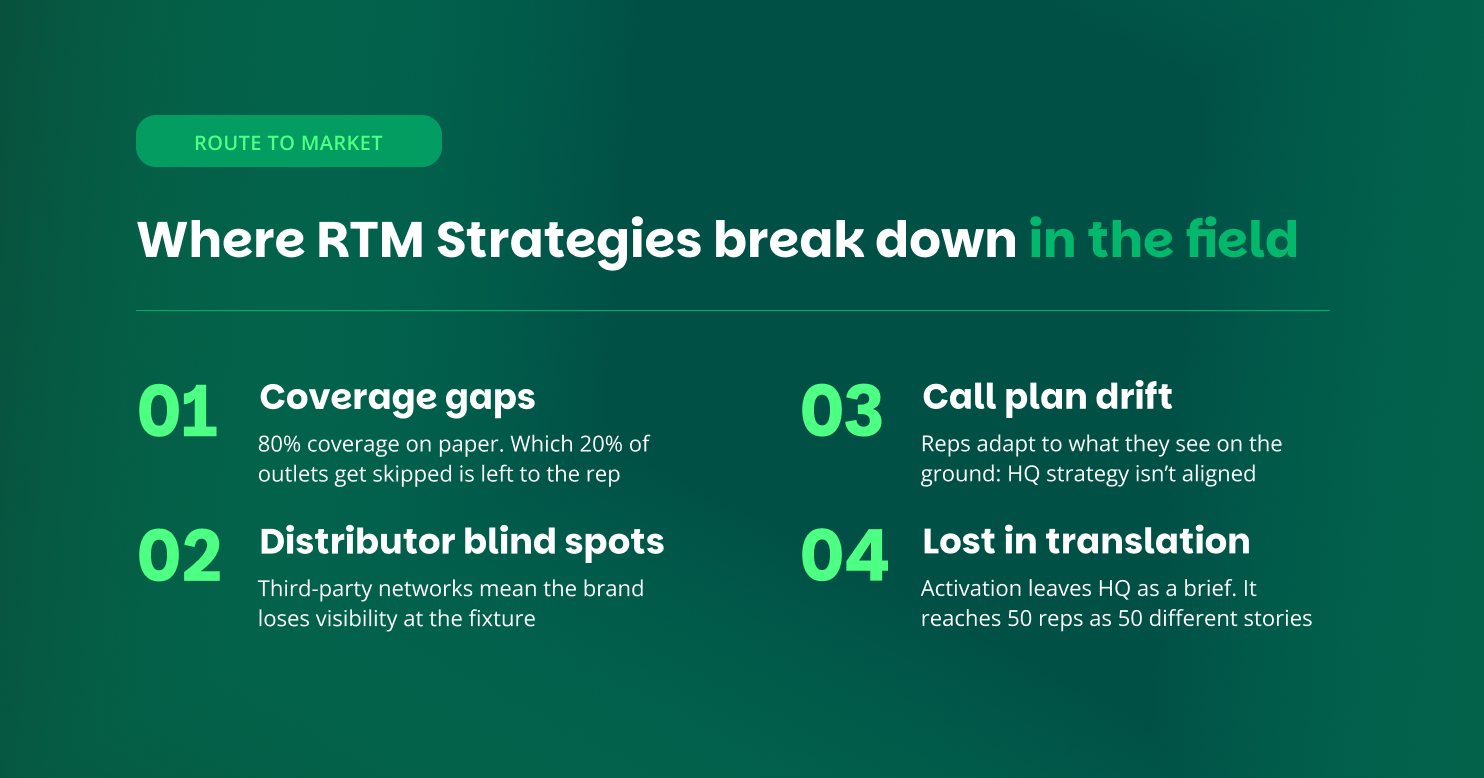
Coverage looks good on paper but has gaps in reality. An outlet segmentation that says 80% coverage of tier-one convenience stores sounds like a clear target. But if the rep responsible for a patch has 60 outlets on their call plan and can realistically visit 40 in a week, the 80% coverage figure is theoretical. Which 40 outlets get visited — and which 20 don't — is often left to the rep's discretion rather than the strategy's logic.
Distributor and wholesaler networks add a visibility layer most brands can't see through. When product moves through a third-party distribution network, the brand loses direct sight of what's happening at the outlet. The distributor's reps are covering the accounts, but their priorities are not always aligned with the brand's activation standards. Promotional mechanics that were agreed at sell-in may never reach the fixture.
Call plans drift from the strategy. Route to market strategies are typically set at the beginning of a period — a quarter, a half-year, a planning cycle. Field reality changes faster than that. New outlets open, accounts change hands, competitor activity shifts the priority ranking. Reps adapt their call plans to what they're seeing on the ground, which is often the right thing to do — but it means the field force is no longer executing the strategy that was designed. It's executing something else, and no one at HQ knows.
The activation standard gets lost in translation. A route to market strategy might define the perfect store standard for a tier-one convenience outlet: three facings in the chiller, a secondary display at the entrance, a promotional shelf strip. By the time that standard reaches the rep, it's been through a briefing, a team meeting, and a two-page PDF. What the rep actually executes varies. Across 50 reps in five markets, that variation compounds fast.
Where Field Sales Fits in Route to Market
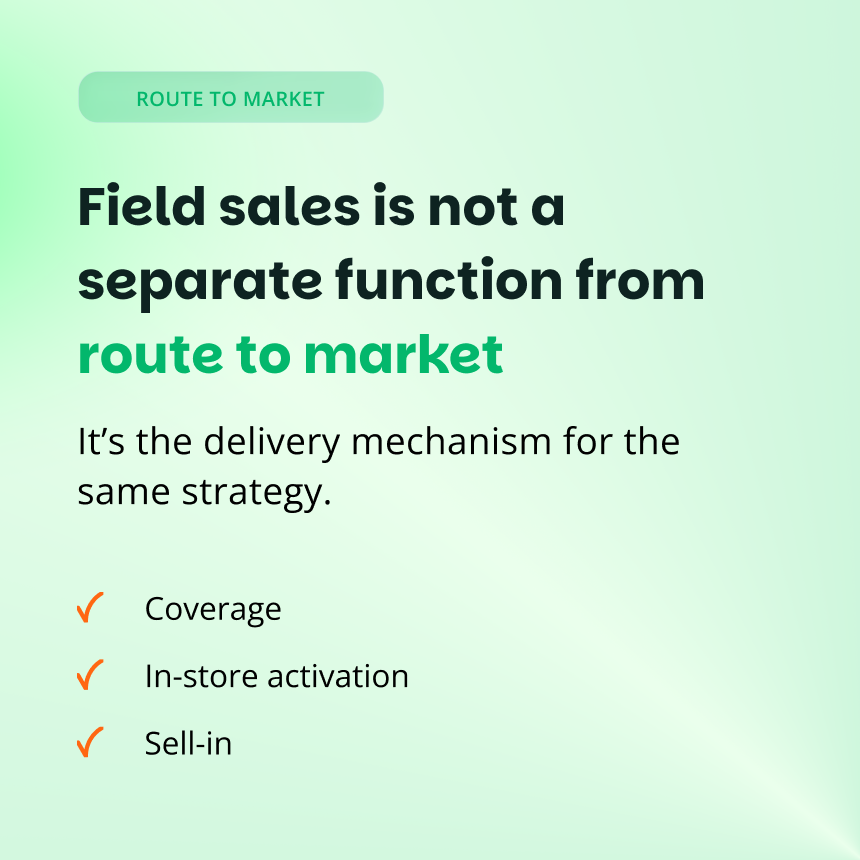
Field sales is not a separate function from route to market. Field sales is the delivery mechanism for the entire strategy.
Every routing decision, every outlet prioritisation call, every activation standard that gets set at the planning stage only has commercial value if a rep executes it correctly at the outlet. Field sales is the last mile of route to market, and like most last miles, it's the hardest to manage and the easiest to underinvest in.
In practice, field sales teams carry three route to market responsibilities:
Coverage execution. Visiting the right outlets, at the right frequency, in the right order. This is call plan adherence at its most basic, but in route to market terms, it's the difference between the strategy reaching 70% of target outlets or 95%.
In-store activation. Executing the agreed activation standard at each outlet: planogram compliance, secondary placements, POS materials, promotional mechanics. This is where the brand's route to market investment either converts into visibility and sales or disappears into a stockroom.
Sell-in and ranging. Field reps are often the primary commercial contact for smaller independent accounts and convenience operators. The route to market strategy's distribution targets depend on reps securing listings, explaining promotional mechanics, and maintaining the relationship that keeps the brand on the fixture.
None of these three things happen automatically. All of them require a field force that is well briefed, well managed, and operating with clear objectives at the outlet level.
How Salesframe Supports Route to Market Execution
The practical problem for most FMCG field sales managers is not understanding what good route to market execution looks like. It's having the tools to see whether it's happening and to course-correct when it isn't.
Salesframe's field sales enablement platform is built around this gap. It gives field teams the content and structure they need to execute consistently at the outlet, and gives sales managers the real-time visibility to know whether the route to market strategy is being delivered on the ground.
Specifically:
Outlet-level KPI tracking shows coverage rates, activation compliance, and call plan adherence by rep, by region, and by outlet segment, so managers can see where the strategy is working and where it's breaking down before the promotion window closes. See how the analytics work →
Centralised content and briefing means every rep carries the same activation brief, the same product information, and the same sales story into every outlet visit — regardless of market or region. The route to market standard doesn't get lost in translation between HQ and the field.
Structured visit reporting captures what actually happened at the outlet, not just that the visit occurred. Photo verification, checklist completion, and outlet-level notes give managers execution data they can act on, not just activity data they can count.
For FMCG brands operating across multiple markets, distributor networks, or van sales operations, this kind of real-time field visibility is the difference between a route to market strategy that delivers and one that looks good in a quarterly review deck while underperforming in the channel.
Key Takeaways
Route to market strategy defines how product reaches the consumer. Field sales execution determines whether it actually does
The four pillars of RTM — channel selection, distribution model, outlet segmentation, and field force design, all depend on consistent field execution to deliver commercial value
Common breakdown points: coverage gaps, distributor visibility loss, call plan drift, and activation standards that don't survive the journey from HQ to the rep
Field sales carries three core RTM responsibilities: coverage execution, in-store activation, and sell-in all of which require clear outlet-level objectives and real-time management visibility
The brands that make RTM strategies work in practice are the ones that treat field execution as a managed process, not an assumed outcome
Running a field team across multiple channels or markets? See how Salesframe helps FMCG and CPG brands close the gap between their route to market strategy and what's actually happening at the outlet.