
One content library, or twelve versions of the same price list?
FMCG field sales teams lose an estimated 60% of their working time to non-selling tasks, and content searching is one of the biggest culprits. Reps dig through SharePoint folders, rebuild decks from scratch, or email PDF attachments that nobody tracks. Meanwhile, the follow-up after a store visit either happens late, happens suboptimally, or does not happen at all. The content problem and the follow-up problem are the same problem. They both start with materials that are scattered, outdated, and invisible once they leave a rep's desktop folder.
Where your sales content actually lives (and why reps cannot find it)
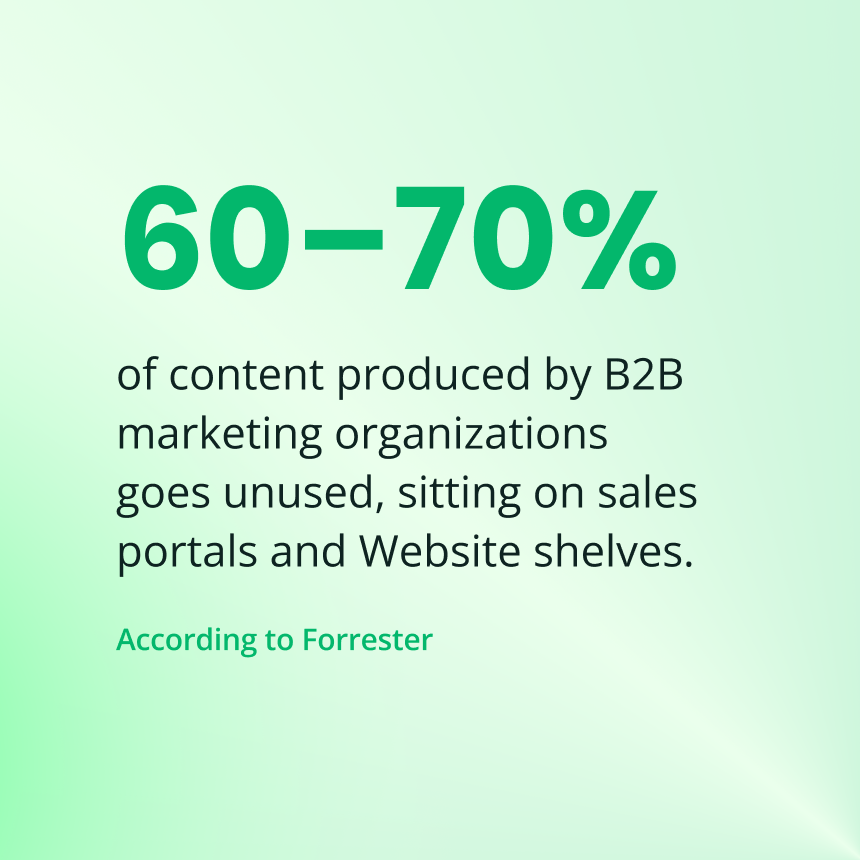
Forrester research found that 60% to 70% of B2B marketing content goes completely unused by sales teams. The reason for this, already back in 2013, was that the content was hard to find and it ended up sitting on (digital, proverbial) shelves. If that problem was flagged already over a decade ago, imagine how bad the situation is these days, after years of cumulative digital waste in online and offline sales systems?
A separate study found that 40% of sales content gets recreated from scratch because the original version is buried somewhere nobody thinks to look. That is marketing spending weeks on a campaign deck, only for a rep to build their own version from memory in a hotel room the night before a buyer meeting. Tons of time wasted for worse results, just because the content management system is not working as intended, or in a worse case, the content management system doesn’t exist.
The pattern is the same in almost every FMCG field team we talk to. Marketing produces the materials, they upload them to SharePoint or a shared drive. A few reps download the new files, but most do not. Within a month, the field team is working from five or six different versions of the “same” pricing sheet, the product one-pager or the campaign presentation. Nobody at head office knows which version a buyer actually saw, or if they saw anything remotely correct at all.
SharePoint is built for storing and organising files by folder structure. Field sales reps need content organised by selling context: which chain, category, campaign, or meeting. When a rep has only a handful of minutes before a store visit, they are not browsing a folder tree, no matter how well-organized it is. They are grabbing whatever they already have on their desktop or in their Downloads folder.
The real cost of scattered content for field sales teams
Salesforce's 2026 State of Sales report found that sales reps spend 60% of their time on non-selling activities, including searching for content, manually entering data, and chasing internal approvals. For a field sales team doing up to 6 or 8 store visits a day, that ratio is unsustainable and taxing for individuals.
The sales enablement research is even more specific. According to a study cited by SiftHub, 84% of sales executives identify content search and utilisation as their top productivity improvement area. The problem is not a lack of content, quite the contrary: the content is there, but not easy to find at the moment it’s needed.
For a 50-person FMCG field team, even 30 minutes a day per rep spent searching for materials, adapting old decks, and recreating content that already exists adds up to 25 hours of lost selling time every day. That is more than three full-time employees worth of productivity disappearing into frustration at the systems or even at the marketing team. It’s bad news both for individual performance (bad mood doesn’t make you perform your best) and team spirit. It’s hard to trust the other team when you have no visibility to their work.
And the cost is not only time or fould mood. When reps use outdated materials, they present wrong pricing, expired promotions, or messaging that marketing retired months ago.
The deals fall through, and no one has any idea why.
What happens after the meeting is even worse
The content problem does not end when the meeting starts; it gets worse when the meeting ends.
Most field reps follow up by emailing an attachment PDF or a PPT. Some do not follow up at all. According to SPOTIO's 2026 Sales Statistics Report, 80% of B2B sales require five or more follow-up contacts to close. Yet 44% of salespeople give up after a single follow-up attempt.
For FMCG field sales, the dynamics are slightly different from enterprise B2B, but the pattern holds. A rep visits a store, presents to the buyer, and then sends a recap email with an attachment. The rep has no way of knowing whether the buyer opened the email, read the attachment, or forwarded it to any other decision-makers. So in the best case, the rep either follows up blind, or worse, follows up too late, or (most commonly, worst) moves on to the next visit and never circles back.
Without engagement data on follow-up materials, reps are guessing when and whether to re-engage. Guessing and betting on deals should be something left for prediction markets, not your field sales reps.
Why email attachments are a dead end for sales follow-up
Consider what happens when a rep emails a PDF after a store visit. The file sits in the buyer's inbox alongside up to hundreds of other emails they received that day. If the buyer opens it, the rep never knows, since even CRM reporting on open rates can be guesswork based on the email client. If the buyer forwards it internally, the rep never knows. If the buyer's colleague has a questions about the pricing slide, they guesswork that internally without you having any clue about the confusion.
With attachments, there is no tracking, nor engagement signals. No way to tell whether the follow-up material influenced the decision or went straight to the digital bin.
Compare that to a trackable follow-up link. The rep sends a simple, lightweight link instead of a multiple MB attachment. The buyer clicks it and views the materials in a branded, mobile-friendly format. The rep sees exactly what was opened, which slides were viewed, how long the buyer spent on each one, and whether the link was shared with anyone else.
That engagement data changes the follow-up conversation. Instead of a generic "just checking in" email three days later, the rep can say: "I noticed your procurement team looked at the pricing section yesterday. Anything I can clarify?" This approach works a lot better, in our experience.
Research from Mindtickle found that companies using digital sales rooms (the category trackable follow-up links belong to) saw a 26% increase in win rate and shortened sales cycles by 10%. For a field sales team that sends dozens of follow-ups a week, those numbers compound quickly.
One content library improves both issues at once
A centralised content library for FMCG field sales does two things that matter.
First, it makes the current version the only version. When marketing updates a price list, every single rep has the new one, and the old one is gone. Reps stop building their own decks because pulling the right slides from the library is faster than starting from scratch: the marketing work is now used, and reps save valuable selling time. Everyone wins.
Second, it connects the content to the follow-up. A rep prepares a tailored presentation from the library, presents it in the store, and sends a trackable link with the same materials after the visit. The whole workflow (prepare, present, follow up, track) happens in one place, with one set of materials, and the engagement data flows back to the rep and the manager.
Salesframe is a field sales enablement platform that gives FMCG and CPG teams a single content library, a presentation builder for tailored store visit decks, and trackable follow-up links with full engagement analytics. The content stays in SharePoint if that is where marketing manages it. Salesframe pulls it through to the field in a format reps can actually use.
What managers see when content and follow-up are connected
The other benefit of a centralized content library is visibility. When content and follow-up live in one platform, the field sales manager can answer questions they could never answer before, for example:
Which materials are reps actually using in the field?
Which content gets shared with buyers most often?
Which follow-up links are opened, and which go cold?
Are reps using the latest campaign materials or still presenting last quarter's deck?
Research from SiftHub found that companies with formal sales enablement programmes achieve 49% higher win rates on forecasted deals. The difference is not magic. It is that managers can see what is working, double down on it, and fix what is not.
For FMCG field sales managers who currently rely on rep self-reporting to know what happened in a store visit, this is a fundamental shift. You go from hoping the team is on message to knowing they are.
The difference between storing content and making it sell
Every FMCG company already has sales content, most likely the marketing team has been producing it for years. The problem has never been volume; fifty percent of all prospect engagement comes from just 10% of sales enablement content, according to Highspot. The other 90% sits unused, according to their study.
The difference is between content that exists somewhere in a system and content that is ready to use in a store visit. Sales enablement content library is the solution to this huge discrepancy between content creation and usage. A well-structured library puts the right materials in front of the right rep at the right moment, in a format they can present from directly.
Salesframe reduces meeting preparation time by roughly 30 minutes per rep per day. For a 50-person field team, that is 25 hours returned to selling every day. The marketing team still owns the content, but now it’s actually in use, and generating learnings for the whole team.
Your reps already know how to sell. Give them one place to find the right materials, one way to follow up with tracking, and one view of what buyers actually engage with.
The rest follows.