
Salesframe vs. gut feeling: how analytics replace guesswork in the field
For years, the honest answer to "how did the promotion go?" was an estimation: either a good one or not. A rep would say the visit "went well,” and a manager would nod and write that down as a report. Still, nobody could say for certain whether the buyer actually looked at the deck, opened the follow-up, or remembered the specific offers presented to them.
Gut feeling ran the field sales report, and gut feeling is a terrible, terrible source of truth in sales.
Salesframe replaces that vibes-based estimation with accurate numbers that tell you what content worked, who used it, and what happened after the rep walked out of the store.
Physical catalogue browsing is a lot harder to track than links.
Why field sales teams still run on the gut feeling
Salesforce's 2026 State of Sales report found that sales reps spend just 40% of their time actively selling, with the rest going to admin, data entry, and searching for content. That is not a productivity issue you can simply fix with a pep talk.
If nobody can see what content gets used, nobody can fix the content. If nobody can see whether a follow-up got opened, "I'll send something over" becomes the end of the story instead of the start of a tracked conversion.
Forrester has reported that 90% of B2B sellers don't use the sales material they're given because it's irrelevant, outdated, or too dfficult to customize. Trade marketing teams keep producing content, reps keep quietly ignoring most of it, and in the worst case nobody finds out until the campaign has already failed in a big chunk of the outlets.
Salesframe analytics exist to get field sales out of that limbo, on both sides of the platform.
What reps see: analytics on the user side
A rep doesn't need a dashboard full of charts between store visits, they need to know one thing fast: did the buyer actually look at what I sent them?
The follow-up link tells the truth. After a visit, a rep sends a trackable link instead of a PDF attached to an email and forgotten by both parties. The rep can then see whether the buyer opened it, which slides they spent time on, and whether they came back to it later.
If the buyer opened the pricing page three times in two days, that's a great place to start the next conversation.
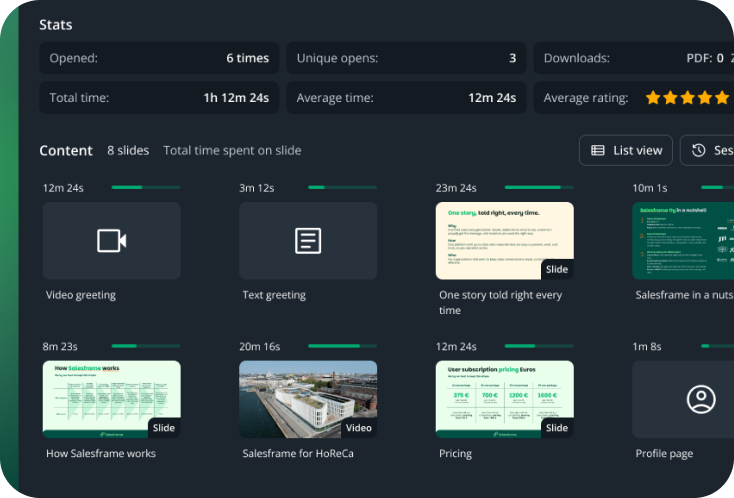
Engagement replaces guessing. Instead of "I think they liked it," a rep gets a thorough view: opened, viewed for four minutes, stopped on the volume discount slide. That's the difference between hoping a deal is warm and knowing it is.
Prep gets faster because the content is already ranked by what works. A rep opening the content library before a visit isn't digging through a shared drive hoping the pricing sheet is the current one. They're picking from materials the team can already see are being used and opened, not just sitting in a folder untouched.
This is the part of analytics that makes reps actually want to use the platform. It's not reporting for reporting's sake. It's a rep finding out, same day, that the buyer is interested, without needing to wait for a callback that might never come.
Reps can also see their full analytics throughout all the sent links. This way they can see which content performs across meetings and follow-ups, making building the perfect deck easy and data-informed.
What managers see: analytics on the admin side
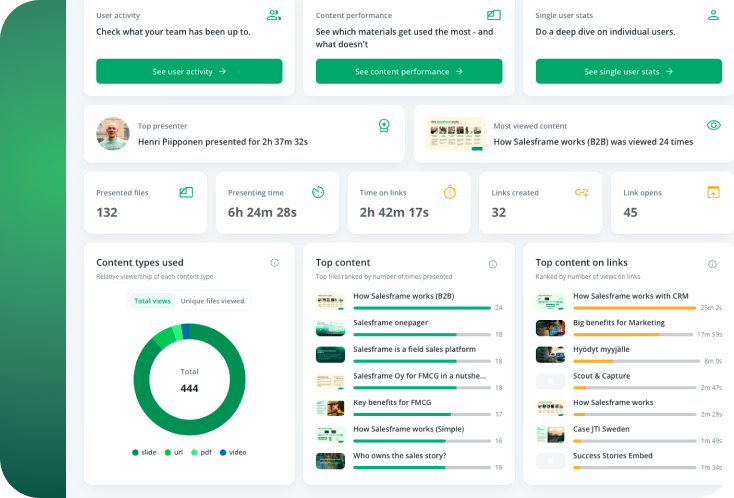
The admin side is where field sales managers and trade marketing teams find out what's actually happening across the whole team, not just one visit.
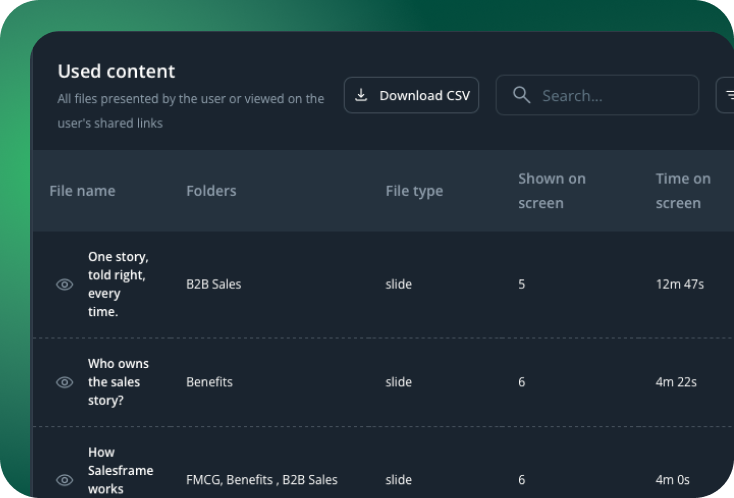
Content usage, at the library level. Which materials get opened. Which ones sit untouched. Industry research suggests roughly 65% of the content sales teams are given goes completely unused. Salesframe's admin analytics show you exactly which half that is for your team, by chain, by market, by campaign, so you stop producing content nobody opens and stop losing time hunting for content that already gets used.
Team-wide engagement. How many presentations got built this week. How many follow-up links went out. How many of those got opened, and by whom. A manager doesn't need to ask ten reps how the campaign launch went, since the numbers are already sitting in the dashboard.
Coverage and consistency across markets. If the Danish team is sending follow-ups and the Benelux team isn't, that shows up in the data.
Where the campaign is actually landing. If a new POS material is getting opened in one chain and ignored in another, that's a signal to adjust the rollout before the whole campaign quietly underperforms.
None of this requires a rep to self-report anything. The data comes from what happened on the platform, which is a nice change from the dreaded gut-feeling report.
User-side vs. admin-side analytics: what each one is for
| User side (rep) | Admin side (manager/marketing) | |
|---|---|---|
| Main question answered | Did this buyer engage with what I sent? | Is our content and team performing across the board? |
| Time frame | Right now, this deal | This week, this campaign, this market |
| Data shown | Link opens, time spent, which slides landed | Content usage, team activity, engagement trends |
| What it replaces | Waiting for a callback | Waiting for the end-of-quarter report |
| Who acts on it | The rep, immediately | The manager or trade marketing team, structurally |
FAQ: Salesframe analytics
What analytics does Salesframe show reps? Reps see whether their follow-up links were opened, how long a buyer spent on specific slides, and which content in the library is actually getting used before they build a presentation.
What analytics does Salesframe show admins and managers? Admins see content usage across the whole team, engagement trends by market or chain, how many presentations and follow-up links reps are sending, and which materials are working and which aren't.
Do reps have to manually report their visit results? No. Engagement data comes from what happens on the platform itself, tracked links, opened content, time spent, rather than from a rep's memory of how the visit went.
Why does content engagement data matter for trade marketing teams? Because it shows which materials actually get used in the field. Without it, marketing keeps producing content based on guesswork about what reps need, and reps keep ignoring most of it.
The bottom line
Gut feeling has never been a strategy. It's just what teams fall back on when nobody's tracking the actual numbers. Salesframe gives reps same-day answers about whether a buyer is engaged, and gives managers a real view of what's working across the whole field team, without waiting for anyone to fill in a report.