
How to structure your sales content library
Most field sales teams have never once discussed how their content is organized. They have discussed the content itself. Endlessly. Which deck to use, which price list is current, whether the case study got approved. Nobody sits down and asks how the folder is structured, because a folder feels like admin, not strategy.
That is the mistake.
Content-based, product catalog, sales playbook, insight-driven, or built around the chains you sell into: the structure you choose decides whether your reps find the right material in ten seconds or dig through three shared drives to find it. Get it wrong and reps improvise. They build their own decks, pull outdated pricing, and send whatever they can find fastest. Get it right and the same structure that organizes your content also becomes the thing that guides how your reps sell.
Here are the five structures we see most often, what each one is built for, and where each one falls apart.
1. Content-based structure: sorted by file type
This is the simplest option. Folders are named for what the content is: presentations, videos, contracts, one-pagers. It is easy to build and easy to understand on day one.
It also does not scale. A content-based structure has no idea what a rep is trying to accomplish. It tells you what a file is, not when to use it. For a small library with a handful of reps, that is fine. For a 200-person field team selling across multiple retail chains, it collapses under its own volume the moment someone adds a fifth product line.
Best for: small teams, early-stage content libraries, internal use rather than customer-facing selling.
2. Product catalog structure: sorted by what you sell
This is the most common structure, and it earns that position. Folders map to product families. Everyone in the organization already thinks in those terms, so nobody needs training to find their way around.
The drawback is built into the name. A product catalog structure is organized around what you sell, not around what the customer is trying to solve. A buyer does not open a meeting wanting to hear about "product family C." They want to know what problem it solves for their shelf, their category, their margin. If your structure only speaks your language, your reps end up translating on the fly, in front of the buyer, which is exactly the moment you do not want them improvising.
Best for: teams with a clear, stable product range and a need to map the full offering clearly.
3. Sales playbook structure: sorted by sales stage
Here, folders follow the shape of the sales conversation itself: why we exist, what we do, the value case, the offer, next steps. Companies that already run a defined sales process see high usage rates with this one, because the structure and the conversation are the same shape. A rep does not have to think about where something lives. They think about where they are in the pitch, and the content follows.
The catch is upfront cost. A playbook structure only works if the playbook exists. If your organization has never mapped out its sales process stage by stage, building this structure means building the sales process at the same time, and that is a bigger project than most people expect when they start.
Best for: teams with an established, repeatable sales process they want every rep following consistently.
4. Insight and customer challenge layers: sorted by the buyer's problem
This one is less a standalone structure and more a layer added on top of any of the above. Instead of only organizing your own materials, you add a section built around the challenges your buyers actually face: rising competition, less face time with customers, an unfamiliar online buying process, a crowded field of similar suppliers.
Adding this layer does not just make content easier to find. It gives reps something sharper to open with. A rep who can speak to the buyer's actual problem before pitching a solution has an edge that a product catalog alone will never give them.
Best for: any team that wants its content to argue on the buyer's terms, not just list what is on offer.
5. FMCG structure: sorted by chain
Built specifically for FMCG and HoReCa field teams, this structure organizes content by retail chain, so a rep walking into Tesco sees Tesco materials, and a rep walking into a 7-Eleven sees something entirely different. For a field team doing five or more visits a day across different retailers, this removes a step that otherwise happens on every single visit: figuring out which version of the content applies here.
It also solves a problem the other four structures do not touch. Communication between chains gets confusing fast when everything is filed by product or by file type instead of by outlet. A chain-based structure keeps the right materials visible to the right people without anyone needing to ask.
Best for: FMCG, CPG, and HoReCa field teams selling the same range across multiple retail chains with different requirements per chain.
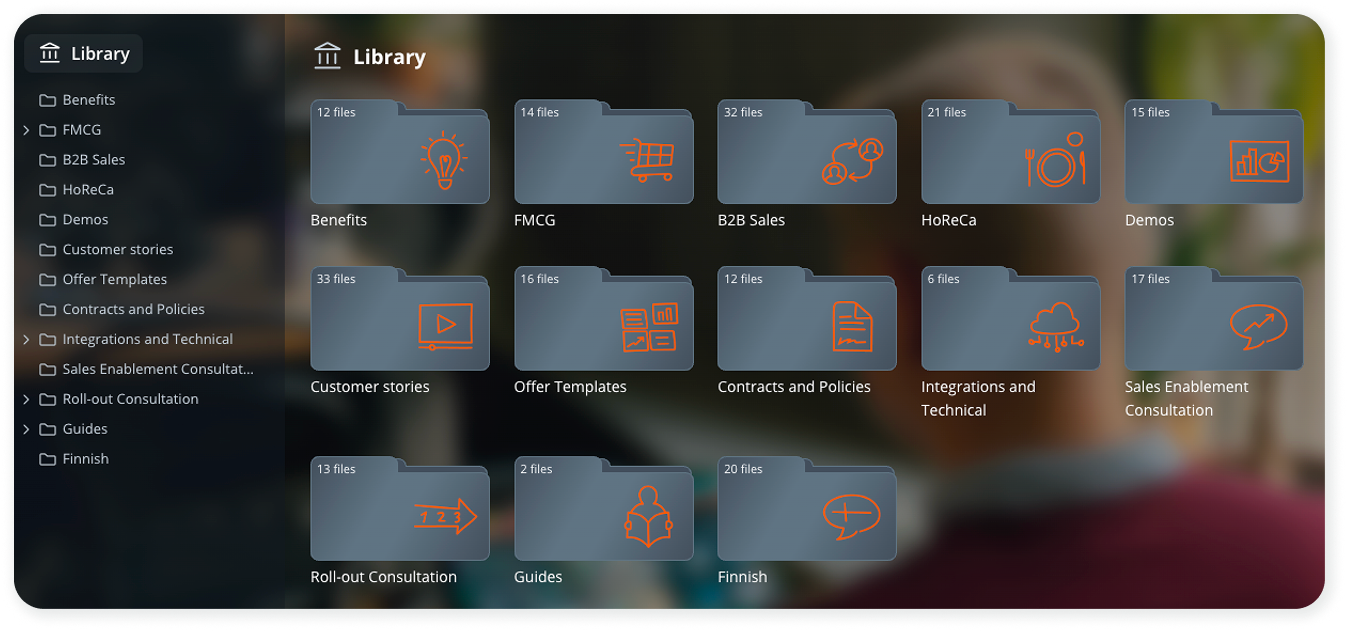
Salesframe team’s folder structure. This structure is a mix of content type and customer challenge (industry-specific).
Which structure is right for your team?
None of these are mutually exclusive. Most organizations that get this right combine two: a product catalog or content-based foundation for the raw materials, with a playbook or chain-based layer on top that tells reps which of those materials to use and when.
The question worth asking is not "which structure is best." It is "what does my content library need to guide my reps toward." A structure built around what you sell will always feel tidy in a admin view and frustrating in front of a buyer. A structure built around how your reps actually sell, chain by chain or stage by stage, takes longer to set up and pays for itself every time a rep walks into a store already knowing exactly what to pull up.
If you are not sure which one fits your team, that is a normal place to start from. Our sales enablement team helps organizations map their own structure before a single file gets uploaded, so the folder you build actually matches the way your reps sell.